
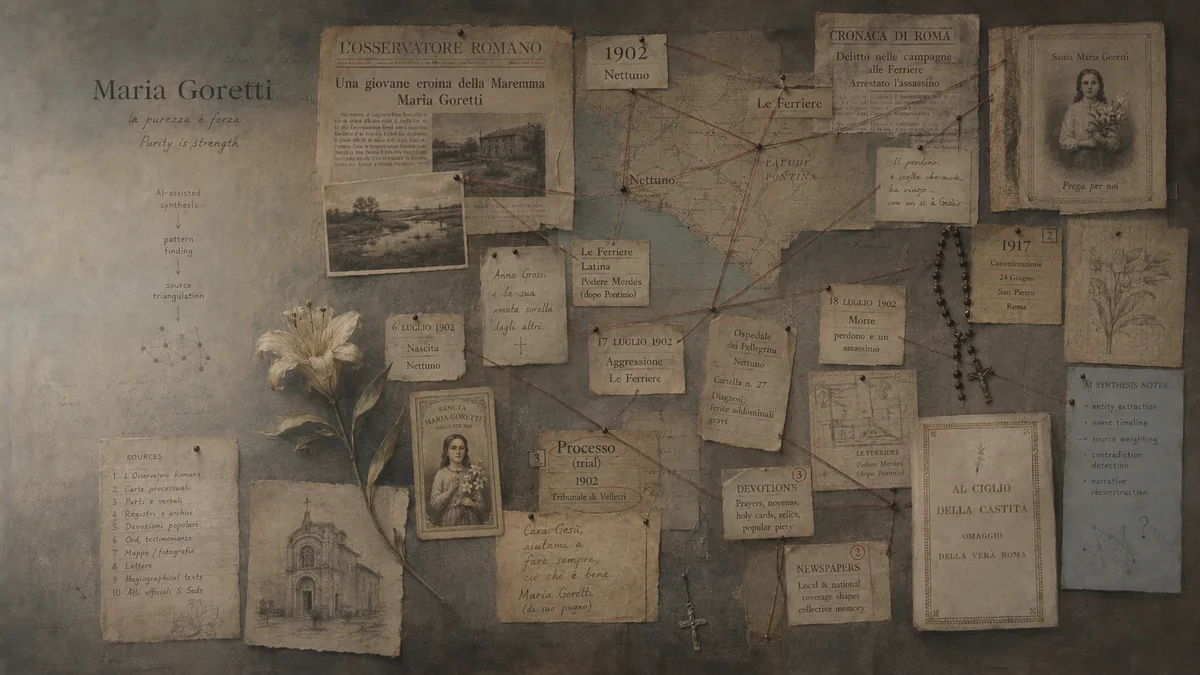
The following document was generated by artificial intelligence. You can read about the process in my blog post, Using AI to Reconstruction Historical Events in my Novel.
Did Maria Goretti forgive Alessandro Serenelli on her deathbed? When was that claim first documented, how did it change over time, who shaped it, and what is the most defensible account of what actually happened?
Method note. This reconstruction works only from the seven sources in Resources/Primary Sources. Nothing here draws on outside knowledge, the internet, or other files. Sources are weighed by evidentiary distance from the event: contemporary records first, then near-contemporary, then later accounts written with a purpose. Where the sources disagree, the disagreement is shown, not smoothed. Citations use each source’s short name plus the paragraph marker [P####] from the extracted text (e.g., Marini 1904, P0125), so every quotation can be traced back. Where the sources are silent, this says so plainly.
1. A note on the sources
The folder is called “Primary Sources,” but it actually holds a mix of primary, near-contemporary, and later secondary works. That mix is exactly what makes the question answerable: we can watch the story change across 120 years.
| # | Source (short name) | Year | Type / stance | Evidentiary weight | Known motive to shape facts |
|---|---|---|---|---|---|
| 01 | Newspapers (Il Messaggero and others) | 1902–1950 | Contemporary journalism | Highest for 1902 | Sensational, but no devotional stake in a pardon |
| 02 | Marini, To the Lily of Chastity | 1904 | Near-contemporary devotional booklet (La Vera Roma / Daughters of Mary) | High, with a purity agenda | Promoting the 1904 monument and a chastity cult |
| 03 | Aurelio, Blessed Maria Goretti | 1947 | Beatification-era hagiography (Passionist) | Moderate; openly devotional | Built to support the Cause; the author was himself a witness/actor |
| 04 | Guerri, Poor Saint, Poor Murderer | 1985 | Secular / revisionist history | Late but critical | Anti-clerical thesis; debunking impulse |
| 05 | Tarantini, The Goretti Trial | 1994 | Secular / feminist, document-driven | Late but critical | Recovering Maria’s voice from the legal record |
| 06 | Thoman (A), Alessandro Serenelli, Murderer… | 2024 | Modern devotional | Latest; consolidating | Edifying redemption story |
| 07 | Thoman (B), Journey into Forgiveness… | 2024 | Modern devotional | Latest; consolidating | The title itself centers forgiveness |
Two structural facts about the evidence matter before we begin:
- The original 1902 criminal-trial record is incomplete. The five days of Assize-Court debate (11–15 October 1902) and the psychiatric reports on Alessandro are physically missing from the Italian state file; the file was transferred out in 1936 and later loaned to the Vatican Secretariat of State in 1953 (Tarantini 1994, P0441–P0442, P0874). The full trial transcript was copied by the Passionist postulator Fr. Mauro Liberati on 17 June 1935 and survives inside the Acts of the Cause in the Vatican archive (Tarantini 1994, P0195). In other words, the people building the sainthood case controlled the primary legal record.
- Even the harshest critic worked at second hand. Guerri, the most aggressive “it was constructed” voice, never read the original criminal trial; he relied on extracts printed in the canonization Positio (Tarantini 1994, P0439). So our certainty has a ceiling, and this document marks it.
2. The headline finding
The forgiveness narrative is absent from the entire contemporary record and from the earliest eyewitness-based account. It enters later, through devotional and canonization channels, and even there it is always prompted.
Three independent bodies of evidence, two of them devotional, converge:
- 1902 journalism (Source 01): Across every article — the crime reports, the follow-ups, the funeral, the 1904 monument, even the 1950 canonization coverage — there is no forgiveness of Alessandro anywhere. The single recorded “last words” of Maria are an accusation: she told Dr. Bartoli “that her murderer had made two other attempts on her virtue and had ordered her not to say anything, threatening her life” (Il Messaggero, 9 Jul 1902, P0065).
- 1904 devotional booklet (Source 02), citing the only named 20-hour eyewitness: Marini quotes Fr. Martino Guijarro, who “assisted her continuously through twenty hours of painful agony” (Marini 1904, P0045). His detailed deathbed account contains no pardon. The only words Maria directs at Alessandro are a rebuke: “What are you doing, Alessandro? You are going to hell!” (Marini 1904, P0124–P0125; also flagged at P0019).
- 1902 legal record (reconstructed in Source 05): No surviving 1902 document has Maria forgiving anyone. The surgeon Dr. Bartoli testified, “I cannot recall her exact words, but she was perfectly lucid” (Tarantini 1994, P0357); the nurse Regina Medei’s detailed 7 July 1902 statement mentions no forgiveness (Tarantini 1994, P0499–P0500). The only forgiveness in any 1902 legal document is the mother’s, Assunta, at the trial on 15 October 1902 (Tarantini 1994, P0808; Guerri 1985, P0771).
So the famous line — “I forgive him, and I want him with me in Paradise” — is not in the 1902 sources, and it is not in the 1904 source built from the bedside witness. It surfaces later. The rest of this document traces exactly when, and how a deathbed “you are going to hell” became a deathbed pardon.
3. Moment-by-moment: the hospital, 5–6 July 1902
What the sources agree on (with minor discrepancies noted in §9):
- The wounding. Around 2–3 p.m. on Saturday 5 July 1902, at the Le Ferriere di Conca farmstead, Alessandro Serenelli (age ~20) attempted to rape Maria Goretti (age ~11½–12). She resisted; he stabbed her fourteen times with an awl (Il Messaggero, 7 Jul 1902, P0005; Marini 1904, P0092–P0099). During the attack Maria cried out a warning — “God doesn’t want this! You’ll go to hell!” — a detail confirmed by Alessandro himself at the 1902 criminal trial and therefore among the most secure facts we have (Guerri 1985, P0646–P0647).
- Transport. A Red Cross stretcher-cart carried her ~14 km to the hospital in Nettuno — variously the “Orsenigo,” “Divine Providence,” or “Fatebenefratelli” hospital, run by the Brothers Hospitallers of St John of God (Il Messaggero, 7 Jul 1902, P0042–P0043; Thoman A 2024, P0075). She arrived in the evening; sources split between ~6:30 p.m. and ~8:00 p.m. (see §9). Her mother Assunta rode with her (Guerri 1985, P0695).
- Confession before surgery. The chaplain Fr. Martino Guijarro heard her confession before the operation, with Assunta’s consent (Marini 1904, P0104–P0106; Aurelio 1947, P0323–P0327; Thoman A 2024, P0075).
- Surgery without anesthesia. Surgeons (Bartoli, Perotti, and a third — Baliva or Onesti, see §9) performed a laparotomy under electric light, lasting about two hours, ending ~10 p.m. They judged the case hopeless from the start: fourteen wounds, heart, lung, and intestine pierced (Marini 1904, P0104–P0111; Aurelio 1947, P0334–P0336; Guerri 1985, P0704–P0705). Guerri
stresses she was “operated on without anesthesia… they tore her apart knowing full well… she would die of septic peritonitis” (Guerri 1985, P0705). - The long night and day. She was moved to a ground-floor women’s room. Attendants included the noblewoman Donna Luisa Cucalon de Bagner (the “charitable foreign lady” the 1902 press credits with staying to the end) and two nuns, Sister Beniamina and Sister Aurelia (Marini 1904, P0113; Aurelio 1947, P0388; cf. Il Messaggero, 10 Jul 1902, P0077). The Archpriest of Nettuno, Don Temistocle Signori, attended (Aurelio 1947, P0366). She received Viaticum and Last Rites and was enrolled in the Daughters of Mary (Marini 1904, P0114–P0117).
- What she kept saying. Across all reconstructions, Maria’s dominant utterances were (a) accusation — “Alessandro swore he would kill me if I told you — and in the end he killed me anyway” (Tarantini 1994, P0241) — and (b) fear of his return — “Don’t let Serenelli come near me” (Aurelio 1947, P0338–P0341; Guerri 1985, P0746; Tarantini 1994, P0289). She also asked repeatedly about her siblings (Thoman A 2024, P0075).
- Death. She died at 3:45 p.m. on 6 July 1902 (per the death certificate, Tarantini 1994, P0586, P0854; Aurelio 1947, P0412), the 1902 press rounding to “4 o’clock” (Il Messaggero, 7 Jul 1902, P0045). Her last word, in Guerri’s reconstruction, was her little sister’s name: “Teresa…” (Guerri 1985, P0747).
It is into hour 6–7 of this episode — the morning of 6 July — that the forgiveness scene is later inserted. The contemporary witnesses to the episode (the surgeon, the nurse, the 1902 journalists) do not record it.
4. The forgiveness claim, examined
4a. The words Maria is actually recorded saying
Set against the famous pardon, here is what the earliest sources actually put in Maria’s mouth at or near the deathbed:
- An accusation (earliest of all): to Dr. Bartoli, that Alessandro had attacked her before (Il Messaggero, 9 Jul 1902, P0065); repeated to her mother (Tarantini 1994, P0241).
- A warning/rebuke, repeated from the attack into her delirium: “What are you doing, Alessandro? You are going to hell!” (Marini 1904, P0124–P0125) — the only thing the 1904 eyewitness account has her say to him.
- Terror and self-protection: “Don’t let Serenelli in!” — which Tarantini pointedly notes is the one request Maria herself initiated, as opposed to the things she merely assented to (Tarantini 1994, P0289, P0525–P0526).
These three — accusation, warning, fear — are the bedrock. They appear in the contemporary and near-contemporary record and are even confirmed, in part, by the killer at trial. The pardon is a different layer.
4b. The forgiveness variants, side by side
Once it appears, the pardon is told many different ways. The wording is not stable — a classic sign of a narrative being shaped rather than transcribed.
| Wording (verbatim) | Source & marker | First documentable date | Who prompts it | Notes |
|---|---|---|---|---|
| “What are you doing, Alessandro? Youare going to hell!“ | Marini 1904, P0125 | 1904 (from Fr. Guijarro) | — (delirium) | Theopposite of a pardon; the earliest deathbed words to Alessandro |
| “I have forgiven him. I will pray for him.Alessandro will come with me to Paradise.“ | Aurelio 1947, P0689; Thoman A 2024, P0099 | 1930 (Barelli, Squilli di Risurrezione, 23 Nov 1930) | Reportedto Alessandro by others | Third person; “for the love of Jesus” absent |
| “Yes, I forgive him too, for the love of Jesus!… and Iwant him to come with me to Paradise!“ | Aurelio 1947, P0390 | 1947 (book; from Signori’s undated note) | Archpriest Signori | After Signori recites the Good Thief promise |
| “May God forgive him, for I have already forgiven him!” | Aurelio 1947, P0392 | 1947 | “those who urged her” | Asecond, different wording in the same book |
| “Yes, I forgive him, and Iwant him with me in Paradise.“ | Guerri 1985, P0740 | 1985 (fromPositio material) | Three pious women (one a countess), after two refusals | Guerri frames it as coerced |
| “I forgive everyone.“ | Guerri 1985, P0741 | 1985 | unspecified | Guerri calls this version “more honest, tender, and cruel” |
| (a “yes” to nurses’ question “Do you forgive your attacker?”) | Tarantini 1994, P0289 | 1994 (from documents) | Catholic Red Cross nurses | No verbatim pardon; only assent, framed as obedience |
| “Yes, I forgive him, and I want himclose to me in Heaven.“ | Thoman A 2024, P0075 | 2024 (cites Alberti 2003) | Archpriest Signori | “Paradise” now rendered “Heaven” |
| “Yes, for the love of Jesus, I forgive him. I want him to be inHeaven with me.“ | Thoman B 2024, P0083 | 2024 (cites Alberti) | Archpriest Signori | Signori first recounts Christ forgiving his executioners |
The drift is visible in the table itself: a 1904 “you are going to hell” becomes a 1930 third-person report, then a 1947 first-person pardon with a Gospel flourish, then settles into the polished modern line. The exact words are never twice the same.
4c. Always prompted, never spontaneous
This is the single most important — and most overlooked — fact. No source, including the devotional ones, presents the forgiveness as something Maria volunteered. In every version, someone asks her first:
- Archpriest Signori asks the leading question (Aurelio 1947, P0390; Thoman A 2024, P0075; Thoman B 2024, P0083; Guerri 1985, P0719).
- Three pious women press her — twice — after she stays silent, escalating to
“If you don’t forgive, the Lord won’t forgive us either” before she answers
(Guerri 1985, P0734–P0740). - Catholic Red Cross nurses ask, and she says “yes” as part of her “proverbial
obedience” (Tarantini 1994, P0289). - Her own mother prompts her at the very end: “forgive everyone” (Aurelio 1947, P0407).
And even the hagiography concedes the forgiveness was hard-won. Aurelio quotes Archpriest Signori’s own written note: Maria forgave only “after overcoming all hesitation and revulsion” (Aurelio 1947, P0391). Guerri reports the Passionists themselves called it “the difficult forgiveness,” and that the effort it cost her “would be held against her during the canonization process” (Guerri 1985, P0719). The Church’s own Devil’s Advocate, Msgr. Natucci, argued in 1942 that “even her forgiveness on her deathbed… was slow and hesitant,” concluding, “I do not see how she can serve as an example” (Guerri 1985, P1009).
4d. The “Paradise” formula was supplied by the priest
The most striking detail is where the famous “with me in Paradise” phrase comes from. In Aurelio’s account, before asking the question, Archpriest Signori “reminded her of Jesus’ death on the Cross, His universal forgiveness, His special mercy toward the repentant thief, and the generous promise He made to him: ‘Today you will be with me in Paradise.’” Only then did he ask, “do you forgive your attacker from the heart?” — and she echoed back, “I want him to come with me to Paradise!” (Aurelio 1947, P0390). Thoman’s Book (B) keeps the same scaffolding: Signori “spoke to Maria about forgiveness, how Christ forgave his executioners while he was dying on the cross,” then asked (Thoman B 2024, P0083).
So the signature line of the whole cult — the wish that her murderer join her in Paradise — is a near-verbatim echo of the Gospel verse the priest had just recited to a dying, exhausted, prompted child. That is not proof she said nothing; it is strong evidence that the specific, quotable formula is a devotional construction laid over, at most, a halting “yes.”
5. Narrative drift: when each claim first appears
Reading the sources in publication order shows the story being assembled piece by piece.
| Date | Source | What it adds to the forgiveness story |
|---|---|---|
| 7–10 Jul 1902 | Newspapers (01) | Crime, surgery, death. Maria’s only quoted words =accusation to Dr. Bartoli (P0065). No pardon. |
| 16 Oct 1902 | Newspapers (01) | Trial, 30-year sentence (P0098–P0101).No pardon. |
| 1904 | Marini (02) | Detailed deathbed from the 20-hour witness Fr. Guijarro. Only words to Alessandro:“you are going to hell” (P0125). No pardon. |
| 11 Jul 1904 | Newspapers (01) | Monument unveiled: “martyr ofhonor,” palms and lilies — a purity cult, not a forgiveness cult (P0112–P0127). |
| ~1904–1910 | (within Aurelio 03) | A devotional prayer by Msgr. A. Marini praises her “generous forgiveness…warning him of hell” — forgiveness and rebuke still fused (Aurelio 1947, P0493). |
| ~1909 | (within Thoman 06) | Alessandro says he “read that she had forgiven me before dying” — so a forgiveness claim isin print by ~1909 (Thoman A 2024, P0095). |
| 23 Nov 1930 | (within Aurelio/Thoman) | Barelli’s article gives a full formula — “Alessandro will come with me to Paradise” — used tocomfort the released killer (Aurelio 1947, P0689; Thoman A 2024, P0099). |
| 1935–1945 | (described by 03/04/05) | The canonization process makes forgiveness central butcontested: Natucci calls it “slow and hesitant” (P1009); witnesses “lied and contradicted themselves” (Guerri 1985, P0994). Decree of Martyrdom (25 Mar 1945) summarizes it as “wholeheartedly forgiving her murderer — wishing him… the joy of Paradise” (Aurelio 1947, P0798). |
| 1947 | Aurelio (03) | First full devotionalscene with direct-quote pardon, scaffolded by the Good Thief verse and admitting “hesitation and revulsion” (P0390–P0391). |
| 24 Jun 1950 | Newspapers (01) | Pius XII’s canonization homily, as the press reports it, isall about purity and “moral corruption” — it does not feature the forgiveness (P0151–P0154). (Tarantini separately records Pius XII elsewhere praising “the heroic forgiveness,” P0150.) |
| 1985 | Guerri (04) | Recovers theprompting and coercion behind the scene; flags the “more honest” variant “I forgive everyone” (P0734–P0741). |
| 1994 | Tarantini (05) | Shows the1902 legal record has no pardon; reframes the “forgiveness” as a prompted “yes” amid accusation and self-protection (P0357, P0289, P0808). |
| 2024 | Thoman (06/07) | Polished, spontaneous-sounding version; concedes “if there had not been forgiveness, there never would have been a Saint Maria Goretti” (Thoman A 2024, P0075). Sources the verbatim to a 2003 sanctuary biography, not a 1902 document. |
The pattern is unmistakable: purity first (1902–1904), forgiveness assembled later (1909 → 1930 → 1935–1947), polished last (2024).
6. Who built the narrative, and why
The sources do not merely let us date the drift; several of them name the people and the motives behind it.
1. A saint needs forgiveness, so the record had to provide it. Thoman states the logic with unusual candor: “If there had not been forgiveness, there never would have been a Saint Maria Goretti” (Thoman A 2024, P0075). Martyrdom in the Christian model requires Christ-like charity toward the killer (the Good Thief, St Stephen). A pure-but-vengeful victim who told her attacker he would “go to hell” could not, by herself, be that model — so the rebuke was reinterpreted as charity (“rather than curse her attacker, she preserved… only the word of charity,” Aurelio 1947, P0637) and the pardon was elevated.
2. The killer’s conversion required Maria’s forgiveness as its engine — and that conversion was actively manufactured. Guerri documents a sustained clergy campaign: the Vera Roma lawyer Marini located Alessandro in Noto prison; bishops and Catholic writers mailed him devotional articles about Maria; Bishop Blandini visited to “grasp Alessandro’s heart with golden tongs.” Guerri’s verdict: “He repented because repentance was what everyone who had reconnected him to the world wanted from him” (Guerri 1985, P0917–P0927). Alessandro himself only learned of the pardon by reading about it (Thoman A 2024, P0095), and his famous lily-dream conversion (Thoman A 2024, P0091; Guerri 1985, P0917) followed that media bombardment.
3. The witnesses were compromised, and the Church’s own reviewer said so. The Devil’s Advocate Natucci found Fr. Aurelio’s accounts should be taken “not without caution,” another biographer’s testimony riddled with “errors and exaggerations,” and Assunta herself caught in lies (e.g., about Maria’s First Communion date) (Guerri 1985, P1001–P1003). Guerri’s global verdict: the two main witnesses, Assunta and Alessandro, “lied and contradicted themselves repeatedly” (Guerri 1985, P0994). Most damaging: Alessandro’s 1902 trial testimony had Maria crying “yes, yes, yes” (seeming to yield) — which would destroy the purity-martyrdom — and he retracted and rewrote it in 1938 under Passionist coaching (Guerri 1985, P0648–P0660; Tarantini 1994, P0362, P0394, P0443).
4. The promoters controlled the documents. The Passionist postulator Fr. Mauro Liberati transcribed the criminal trial in 1935; the originals of the trial debate and the psychiatric reports then went missing from the state archive, and the surviving copy lives in the Vatican (Tarantini 1994, P0195, P0441–P0442). Even Guerri had to work from Church-printed extracts (Tarantini 1994, P0439).
5. Politics supplied the urgency. Guerri ties the timing to its era: Mussolini encouraged elevating a girl of “Italian and strong virtue”; and when, by 1944, the Catholic and Axis armies had collapsed and Allied troops were “sweeping through Italy,” the Church wanted “a virgin and martyr… to stand against moral decay,” which is why resistance to a shaky cause suddenly “faded” and Pius XII pushed it
through “with extraordinary speed” (Guerri 1985, P0009). Tarantini agrees the martyrdom was “intelligently adapted to the spirit of the times” (Tarantini 1994, P0410).
None of this requires anyone to have invented a pardon from nothing. It requires only what the sources actually show: a halting, prompted “yes” from a dying child, selected, polished, and amplified by people who needed it to mean something.
7. How likely is it true?
We have to separate three different claims, because they are not equally supported.
Claim A — “Maria, unprompted, made an eloquent deathbed pardon: I forgive him and I want him with me in Paradise.“
Very unlikely as usually told. This spontaneous, verbatim version is contradicted by the silence of every 1902 source and the 1904 eyewitness account, and it is undercut by the devotional sources’ own admissions that she was asked first, that the priest supplied the “Paradise” phrase, and that she answered only “after overcoming all hesitation and revulsion.”
Claim B — “Maria, under heavy prompting from clergy, nuns, pious bystanders, and her mother, eventually assented to forgive.”
Plausible, even probable. Hostile and devotional sources converge here. Guerri and Tarantini — no friends of the cult — accept that she gave some assent; they simply describe it accurately as solicited. A devout, dying 11-year-old, surrounded by people telling her this is what a good Christian does, very likely said “yes,” and may have echoed the priest’s words or said something like “I forgive everyone” (Guerri 1985, P0741).
Claim C — “Maria’s dominant, self-generated stance toward Alessandro was accusation, fear, and warning.”
Strongly supported. This is the bedrock of §4a: the 1902 press, the 1902 legal witnesses, the 1904 eyewitness, and even the killer’s own trial testimony all point here. It is the part of the record nobody had a motive to invent.
Bottom line. The honest historical verdict is that the event behind the forgiveness story is real but modest — a prompted assent — while the story told about it is a later, theologically-shaped elaboration. The popular image of a serene child spontaneously pardoning her murderer is not supported by the sources; the most that the evidence will bear is a frightened, accusing, dying girl who, pressed by priest and mother, managed a difficult “yes.”
Uncertainty, stated plainly. We cannot fully close the case, because the original 1902 trial debate and psychiatric files are lost, the surviving trial copy is held by the institution that promoted the cause, and even the leading skeptic worked from second-hand extracts (Tarantini 1994, P0195, P0439, P0441). What we can say with confidence is negative and chronological: the forgiveness is not in the contemporary record, it is always prompted where it does appear, its wording never stabilizes, and its “Paradise” formula traces to the priest’s own lips.
8. The most defensible reconstruction
Putting only what the sources support, in order:
Fatally stabbed defending herself on 5 July 1902, Maria was carried to the Nettuno hospital and operated on without anesthesia. Through roughly twenty conscious hours she accused Alessandro by name, feared he would come back (“Don’t let Serenelli in”), and repeated the warning she had cried during the attack (“God doesn’t want this; you’ll go to hell”) — the words even her killer confirmed at trial. On the morning of 6 July, clergy and pious attendants — the Archpriest Signori, nursing nuns, devout bystanders, and her mother — asked her to forgive. After hesitation, and after the priest had recited Christ’s promise to the Good Thief, she assented, in words later remembered and rendered many different ways, possibly “I forgive everyone.” She died at 3:45 p.m. Over the following decades — as her killer’s conversion was cultivated and her cause for sainthood advanced — that solicited “yes” was selected, scripted into direct speech, fitted with the Gospel’s “with me in Paradise,” and made the emotional engine of both her canonization and his redemption.
That is the version that survives contact with all seven sources. It is less tidy than the holy card and less cynical than pure fabrication — which is usually where the truth of such episodes sits.
9. Discrepancies and open questions
Factual discrepancies among the sources
- Arrival time at the hospital: ~8:00 p.m. (Il Messaggero, 7 Jul 1902, P0043; Thoman A 2024, P0075) vs ~6:30 p.m. (Marini 1904, P0104; Aurelio 1947, P0321).
- Third surgeon’s name: “Baliva” (Il Messaggero, 7 Jul 1902, P0044) vs “Onesti” (Marini 1904, P0104; Aurelio 1947, P0323; Thoman A 2024, P0075). Autopsy doctors are given as Impallomeni and Bartoli (Tarantini 1994, P0593).
- Time of death: “4 o’clock” (Il Messaggero, 7 Jul 1902, P0045) vs the recorded 3:45 p.m. (Tarantini 1994, P0586; Aurelio 1947, P0412).
- Who kept the 20-hour vigil: Fr. Guijarro (Marini 1904, P0045) vs Archpriest Signori (Aurelio 1947, P0400). The two roles get blurred across sources.
- Who prompted the forgiveness: Archpriest Signori (Aurelio 1947; Thoman; Guerri 1985, P0719) vs three pious women/a countess (Guerri 1985, P0734) vs Catholic Red Cross nurses (Tarantini 1994, P0289) vs the mother (Aurelio 1947, P0407). Likely several of these, sequentially.
- Date of Alessandro’s lily-dream: the end of his three-year solitary confinement, ~1905 (Thoman A 2024, P0091), vs 1910 (Guerri 1985, P0917).
- Date Alessandro sought Assunta’s forgiveness: Christmas 1934 (Tarantini 1994, P0208; Thoman A 2024, P0101) vs Christmas 1937 (Aurelio 1947, P0701).
- Maria’s age: “twelve” in most devotional texts; “eleven years, eight months” (Thoman A 2024, P0075); some 1902 papers said “fourteen” (Il Giornale d’Italia, 8 Jul 1902, P0060).
- The forgiveness wording itself: at least eight non-identical versions (see §4b).
Open questions the seven sources cannot settle
- When was Archpriest Signori’s “biographical note” actually written? Aurelio leans on it as the primary source for the deathbed dialogue but gives it no date (Aurelio 1947, P0375, P0391, P0208). If it was written in 1902, the pardon has an early anchor; if decades later, it is part of the canonization-era construction. This single undated document is the crux of the whole question, and the sources do not resolve it. (Tellingly, Marini in 1904 did not use any Signori pardon — he used Guijarro’s “you are going to hell.”)
- What did the lost 1902 trial-debate transcripts contain? They might hold contemporary witness testimony about the deathbed — but they are missing, and the surviving copy is in Vatican hands (Tarantini 1994, P0195, P0441–P0442).
- Did Maria utter the specific “Paradise” formula, or only a “yes” later rendered as direct speech? The sources that quote the formula (Aurelio, Thoman) trace it to undated or late material (Signori’s note; Alberti’s 2003 biography), while the document-driven sources record only assent (Tarantini 1994, P0289).
- How far did Passionist control of the archive shape what we can ever know?
With the postulators transcribing and housing the record, and the Devil’s Advocate himself doubting the witnesses, the reliability ceiling is real and permanent (Guerri 1985, P1009, P0994; Tarantini 1994, P0439).